Three Strategic Technology Programs Defining the Future of Enterprise Competitiveness
Across global boardrooms, enterprise leadership discussions are undergoing a profound shift. The conversation is no longer centered on whether organizations should digitize. That debate has effectively ended. The real strategic question facing executives today is far more consequential: how can organizations remain competitive, adaptive, and resilient in an economy increasingly shaped by artificial intelligence, automation, and digital acceleration?
This question is redefining enterprise leadership itself. Technology transformation is no longer viewed as a support function focused on infrastructure maintenance, software deployment, or operational cost efficiency. Instead, technology has become the foundation upon which organizational agility, decision intelligence, customer experience, resilience, and innovation are built.
As a result, the role of the modern Chief Information Officer has evolved dramatically. The CIO is no longer simply responsible for managing enterprise systems and ensuring uptime. Today’s CIO is increasingly expected to operate as a strategic architect of enterprise capability. The position now sits at the intersection of business strategy, operational transformation, cybersecurity, data intelligence, and innovation governance.
Organizations that succeed over the next decade will not necessarily be those with the largest technology budgets. They will be the organizations capable of aligning enterprise architecture with long-term business capability development. Competitive advantage will increasingly depend on how effectively enterprises build intelligent, scalable, and resilient digital operating models.
Within this environment, three strategic technology programs are emerging as foundational priorities for every enterprise CIO:
- Enterprise Data and AI Foundations
- Intelligent Process Automation Transformation
- Cyber-Resilient Digital Platform Modernization
Together, these initiatives form the operational architecture of the modern intelligent enterprise.
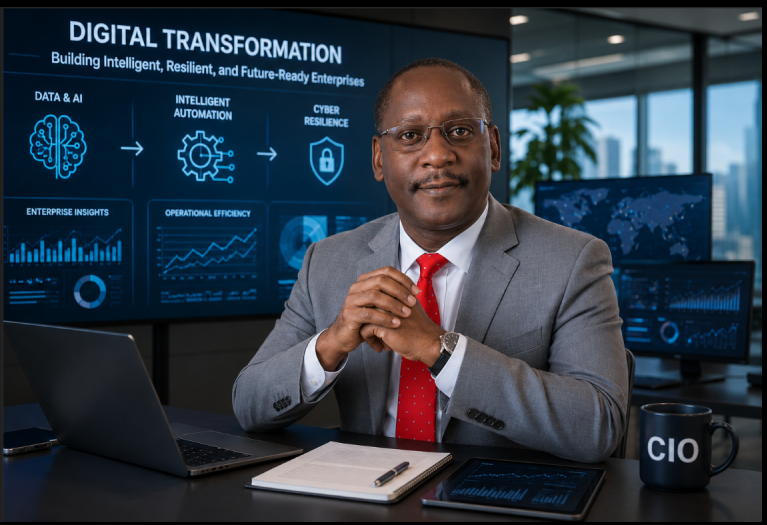
Enterprise Data and AI Foundations: Building the Intelligence Layer for Modern Enterprises
Artificial intelligence now dominates executive conversations across virtually every industry. However, many organizations continue to underestimate a critical reality: AI systems are only as effective as the quality, accessibility, governance, and integration of the data that powers them.
Despite substantial investments in enterprise software over the last two decades, many organizations still operate with fragmented data ecosystems spread across disconnected business applications, legacy operational systems, spreadsheets, customer platforms, financial tools, and third-party environments. In many enterprises, data exists in silos that prevent leadership teams from obtaining a unified operational view of the organization.
The consequences of fragmented enterprise data are substantial. Organizations frequently experience inconsistent reporting, delayed decision-making, duplicated operational effort, poor customer visibility, limited forecasting capability, and weakened strategic planning. Executive teams often spend more time reconciling data discrepancies than generating actionable business intelligence.
This is precisely why enterprise data modernization has become the first strategic priority for forward-looking CIOs.
Modern enterprise competitiveness increasingly depends on the ability to create unified intelligence layers that connect operational systems, business workflows, customer interactions, and strategic analytics into a single governed ecosystem. The goal is not simply to collect data, but to transform enterprise information into a continuously evolving decision capability.
A modern enterprise data and AI foundation typically includes cloud-scale data lakehouse environments, enterprise integration platforms, API-enabled data services, master data management systems, metadata governance frameworks, real-time analytics pipelines, and AI-ready operational architectures. Together, these components establish the digital intelligence backbone of the organization.
Once unified intelligence platforms are established, enterprises gain the ability to move beyond reactive reporting models toward predictive operational management. Organizations can forecast customer demand more accurately, detect operational inefficiencies faster, strengthen financial planning, personalize customer experiences, improve compliance visibility, and deploy AI copilots capable of augmenting workforce productivity.
The strategic implications are significant. Data is no longer simply a reporting asset. It has become a competitive capability.
This shift is particularly important for African enterprises undergoing rapid digital expansion while simultaneously navigating fragmented operational environments, infrastructure disparities, regulatory complexity, and accelerated mobile-first market growth. Across sectors such as banking, logistics, healthcare, agriculture, telecommunications, and public services, organizations have an opportunity to leapfrog traditional digital maturity stages by building modern AI-ready enterprise architectures from the outset.
Financial institutions, for example, are increasingly using intelligent data platforms to improve fraud detection, automate compliance analysis, and enhance customer risk profiling. Logistics organizations are leveraging predictive analytics to optimize routing and supply chain efficiency. Agricultural technology platforms are using data intelligence to forecast climate variability and improve distribution planning. Healthcare providers are adopting analytics-driven operational models to improve service delivery and patient outcomes.
In each case, the organizations establishing strong enterprise data foundations today are positioning themselves to achieve long-term structural advantages in decision-making and operational intelligence.
The future competitive landscape will increasingly favor organizations capable of transforming enterprise data into strategic foresight.
Intelligent Process Automation: Scaling Enterprise Operations Through Workflow Intelligence
For many organizations, digital transformation has historically meant converting manual paper processes into digital workflows. While this represented progress, digitization alone does not necessarily create operational efficiency.
A slow, fragmented, and approval-heavy process does not become efficient simply because it is moved into software.
This distinction is becoming increasingly important as enterprises seek to scale operations in increasingly competitive and volatile markets. Organizations now require operational models capable of delivering speed, consistency, transparency, and agility without proportionally increasing complexity or workforce overhead.
This is where Intelligent Process Automation is becoming a defining strategic priority.
Unlike traditional automation approaches that focused primarily on isolated task execution, modern intelligent automation focuses on end-to-end workflow orchestration. The objective is not simply to automate individual tasks, but to redesign enterprise operating models around intelligent, event-driven, AI-assisted workflows.
Modern intelligent automation architectures typically integrate Business Process Management platforms, Robotic Process Automation capabilities, AI-powered document processing, workflow orchestration engines, event-stream processing systems, operational dashboards, and enterprise integration middleware. These technologies work together to create interconnected operational ecosystems capable of dynamically managing enterprise workflows in real time.
The strategic value of intelligent automation extends across nearly every business function. Finance departments are using automation to streamline reconciliation and reporting. Procurement teams are accelerating approvals through policy-driven workflows. Human resource departments are automating employee lifecycle management. Customer service operations are improving onboarding experiences through AI-assisted processing. Compliance functions are enhancing audit visibility and regulatory traceability through automated governance controls.
The impact on enterprise performance is both measurable and immediate.
Organizations implementing intelligent automation consistently report reduced operating costs, faster turnaround times, stronger audit controls, improved customer experience consistency, and higher workforce productivity. More importantly, intelligent automation allows enterprises to scale operational capacity without introducing proportional administrative complexity.
One of the most important misconceptions surrounding automation is the assumption that it exists primarily to replace human workers. In reality, the most successful automation programs focus on augmenting human capability rather than eliminating it.
High-performing organizations are increasingly using automation to redirect employees away from repetitive administrative coordination toward higher-value activities such as innovation, customer engagement, strategic planning, service optimization, and relationship management.
This shift represents a broader evolution in enterprise operating philosophy.
Over the next decade, operational intelligence will become one of the most important differentiators between market leaders and lagging organizations. Enterprises that continue relying heavily on fragmented manual coordination, disconnected workflows, and inefficient approval chains will face increasing difficulty scaling competitively.
Meanwhile, organizations that implement intelligent workflow orchestration will achieve substantial advantages in agility, execution speed, operational transparency, and customer responsiveness.
In sectors such as financial services, healthcare, manufacturing, logistics, government services, and telecommunications, these operational advantages compound significantly over time. Faster execution improves customer trust. Improved visibility strengthens governance. Reduced friction enhances scalability. Increased agility accelerates innovation.
Intelligent automation is therefore no longer an operational optimization initiative. It is rapidly becoming a foundational business competitiveness strategy.
Cyber-Resilient Digital Platform Modernization: Securing the Future Enterprise
As enterprises accelerate digital transformation, cybersecurity has evolved far beyond the boundaries of traditional IT risk management. It has become a board-level issue directly tied to business continuity, regulatory compliance, operational resilience, and enterprise reputation.
The modern enterprise operates within a highly interconnected digital ecosystem characterized by cloud platforms, mobile workforces, SaaS applications, API-driven integrations, distributed infrastructure, and AI-enabled operational models. While these advancements create enormous business opportunities, they also introduce substantial cyber risk exposure.
Unfortunately, many organizations continue to operate on legacy infrastructure environments that were never designed for today’s digital threat landscape.
Common enterprise challenges include tightly coupled legacy applications, fragmented security controls, inconsistent identity governance, aging infrastructure dependencies, weak disaster recovery capabilities, and limited operational observability. These weaknesses not only increase cybersecurity risk but also slow innovation, reduce agility, and constrain scalability.
This is why cyber-resilient digital platform modernization has become one of the most important strategic technology programs for enterprise CIOs.
Future-ready organizations are increasingly adopting hybrid cloud architectures, API-first integration strategies, centralized observability platforms, automated disaster recovery orchestration, identity-centric access controls, and zero-trust security frameworks. These modernization initiatives are not merely technical upgrades. They represent strategic investments in enterprise resilience and adaptability.
Organizations with modern digital platforms are able to launch new services faster, integrate external partners more efficiently, improve compliance visibility, reduce operational downtime, and scale digital operations more effectively. Most importantly, they create enterprise environments capable of adapting continuously to evolving business demands.
Among the most significant architectural shifts currently reshaping enterprise security is the transition toward zero-trust architecture.
Traditional perimeter-based security models assumed that systems and users operating inside the organizational network could generally be trusted. In a cloud-connected world, this assumption is increasingly ineffective.
Modern enterprises operate across remote work environments, mobile devices, distributed cloud infrastructure, third-party ecosystems, and SaaS platforms. Security boundaries have become fluid and decentralized.
Zero-trust security models address this reality by adopting an identity-centric approach to enterprise protection. Under zero-trust principles, no user, device, application, or system is automatically trusted. Access is continuously verified, privileges are minimized, activity is monitored in real time, and policies are dynamically enforced.
This significantly reduces enterprise exposure to credential compromise, insider threats, unauthorized access, and lateral movement attacks.
Cyber resilience is therefore no longer simply about preventing attacks. It is about ensuring operational continuity in an increasingly unpredictable digital environment.
Organizations capable of building resilient digital platforms will possess stronger foundations for innovation, scalability, and long-term growth.
The Rise of the Integrated Enterprise Capability Stack
While each of these three strategic programs delivers substantial independent value, their true transformative power emerges when implemented together as part of a unified enterprise architecture strategy.
Secure digital infrastructure provides resilience and scalability.
Intelligent process automation creates operational agility and execution efficiency.
Enterprise data and AI foundations enable predictive intelligence and decision advantage.
Together, these capabilities form what can best be described as the integrated enterprise capability stack — the operational model increasingly defining global market leaders.
This integrated approach enables organizations to transition from fragmented technology environments into adaptive digital enterprises capable of evolving continuously alongside changing market conditions.
The enterprises that dominate the next decade will not simply deploy more technology. They will build more intelligent organizational capability systems.
The Future CIO as the Architect of Enterprise Competitiveness
The evolution of enterprise technology is fundamentally reshaping executive leadership expectations. The future CIO will not be evaluated solely on infrastructure stability or project delivery metrics. Increasingly, CIOs will be measured by their ability to architect organizational capability, enable operational intelligence, strengthen enterprise resilience, accelerate innovation, and align technology transformation directly with strategic business outcomes.
This requires a fundamental shift away from viewing technology initiatives as isolated IT projects. Modern CIO leadership demands capability-driven transformation thinking. Technology strategy is now inseparable from business strategy. Enterprise architecture has become a competitive instrument. Cyber resilience is now business resilience. Data intelligence is now strategic intelligence.
The organizations that recognize this shift early will be significantly better positioned to compete in increasingly digital global markets. The next decade will reward enterprises capable of adapting faster, automating intelligently, making data-driven decisions, and maintaining operational resilience under constant disruption.
These capabilities will not emerge accidentally. They must be designed deliberately, governed strategically, and executed consistently.
Enterprise Data and AI Foundations enable organizational intelligence.
Intelligent Process Automation enables operational scale and agility.
Cyber-Resilient Digital Platform Modernization enables continuity, adaptability, and innovation.
Together, these three strategic technology programs form the operating framework of the modern intelligent enterprise. For CIOs, technology leaders, and enterprise architects, the strategic mandate is becoming increasing ly clear: the future belongs not to organizations that merely deploy technology, but to those that successfully build intelligent digital capability platforms capable of sustaining long-term enterprise competitiveness.
Follow me on Linkedin to get more insights on AI and use of Artificial intelligence in business operations