For years, businesses approached artificial intelligence as a tool for efficiency. AI summarized reports, automated customer chats, analyzed spreadsheets, and accelerated workflows that humans still controlled from beginning to end. That phase is ending. A more transformative era is now emerging — one where AI systems no longer simply respond to instructions, but instead act with initiative, context awareness, memory, and decision-making capability. This is the rise of agentic AI.
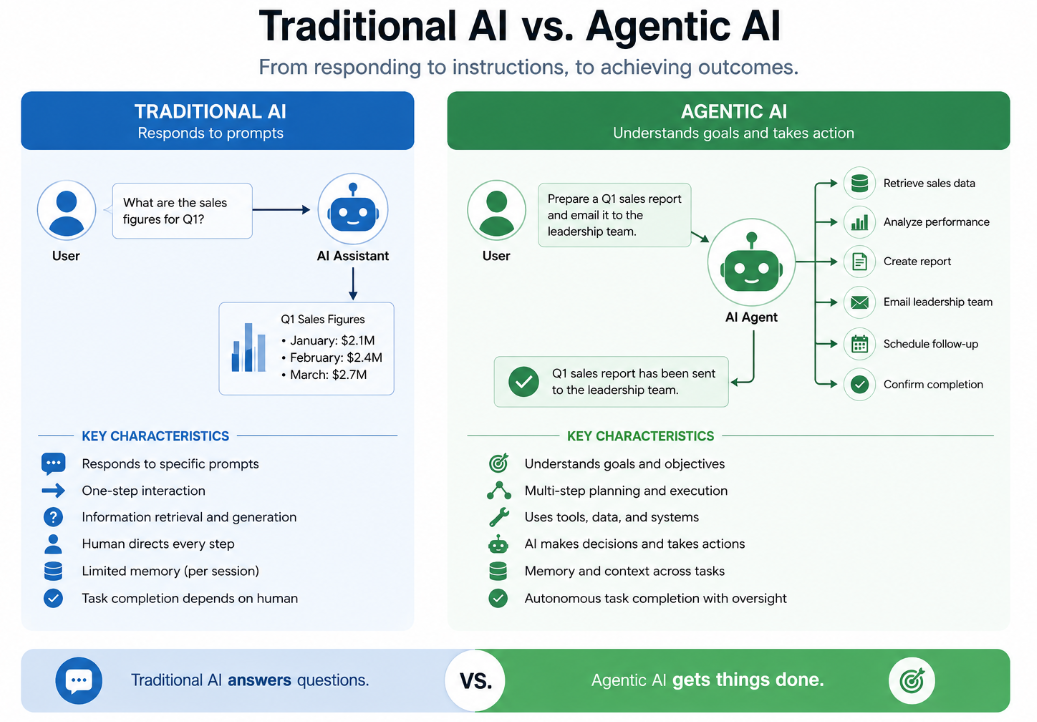
Agentic AI represents a structural shift in how organizations operate. It moves artificial intelligence from passive assistance to active participation in business execution. These systems can independently pursue objectives, coordinate across multiple tools, make operational decisions within defined limits, and continuously optimize outcomes based on changing conditions. For business leaders, the significance of this transition cannot be overstated. Agentic AI is not another productivity application layered onto existing systems. It is rapidly becoming the digital workforce layer that will redefine operational models across industries. The organizations that understand this early will not merely automate faster. They will fundamentally redesign how work gets done.
From Automation to Autonomous Operations
Traditional automation has always depended on predefined rules. A workflow starts when a trigger occurs, and the system executes a fixed sequence of actions. While useful, this approach is rigid and fragile. It struggles in environments where decisions change dynamically or where contextual understanding matters. Agentic AI changes this paradigm entirely.
Instead of following static instructions, agentic systems operate around goals. They can interpret intent, evaluate multiple paths, access enterprise systems, collaborate with other AI agents, and adapt their behavior as circumstances evolve. Consider a modern procurement operation. In a conventional environment, procurement teams manually review supplier quotes, verify budgets, obtain approvals, monitor inventory, and coordinate with finance and logistics teams.
An agentic AI system can orchestrate much of this end-to-end process autonomously. It can monitor stock levels in real time, predict shortages before they occur, request supplier quotations, evaluate vendor performance histories, negotiate within approved pricing thresholds, seek human approval only for exceptions, generate purchase orders, update ERP systems, and track delivery timelines. What previously required multiple teams and several days can occur continuously and intelligently in near real time. The implications extend far beyond operational efficiency. Businesses gain responsiveness, scalability, and resilience that traditional organizational structures struggle to achieve.
The Emergence of AI as a Digital Workforce
One of the most misunderstood aspects of agentic AI is the assumption that it is simply a more advanced chatbot. In reality, agentic AI is closer to a digital workforce model. An AI agent can now function as a customer service coordinator, a financial analyst, a procurement assistant, a compliance reviewer, a cybersecurity responder, a sales operations manager, a logistics planner or even a marketing optimization engine. The difference is that these agents are not isolated tools. They can collaborate.
A sales agent may identify declining customer engagement patterns. It can then trigger a marketing agent to launch a retention campaign, notify a finance agent to evaluate pricing incentives, and engage a customer support agent to proactively contact high-risk accounts. This interconnected operational intelligence introduces something businesses have historically lacked: organizational responsiveness at machine speed. In highly competitive markets, that responsiveness becomes a strategic advantage.
Operational Intelligence Becomes Continuous
Most organizations still operate in periodic cycles. Reports are reviewed weekly. Forecasts are updated monthly. Strategic adjustments happen quarterly. Agentic AI compresses these timelines dramatically. Businesses can move toward continuous operational intelligence where monitoring, analysis, decision-making, and execution occur constantly in the background.
In supply chain management, agentic AI systems can continuously monitor geopolitical developments, weather patterns, transportation disruptions, fuel costs, and supplier reliability simultaneously. Instead of waiting for disruption to happen, the system proactively reroutes logistics operations or adjusts sourcing strategies before a crisis escalates.
In finance, agentic systems can continuously monitor spending anomalies, cash flow patterns, fraud indicators, and regulatory compliance exposures in real time.
In customer experience environments, AI agents can dynamically personalize interactions based on behavioral changes, purchasing history, sentiment analysis, and support engagement patterns.
The business no longer reacts slowly to information. The organization evolves into an adaptive system capable of responding continuously.
Why Small and Medium Enterprises Should Pay Attention
Historically, sophisticated operational intelligence was accessible primarily to large enterprises with significant technology budgets. Agentic AI changes that equation. Small and medium enterprises across Africa and emerging markets now have the opportunity to operate with capabilities that previously required large operational teams and expensive enterprise platforms.
A small logistics company can deploy AI agents to optimize fleet routing, automate invoicing, track fuel efficiency, and coordinate customer communications.
A retail business can use agentic systems to forecast inventory demand, automate supplier coordination, manage digital marketing campaigns, and personalize customer engagement.
A healthcare provider can deploy AI agents for appointment coordination, patient communication workflows, claims processing, and compliance monitoring.
The democratization of operational intelligence may become one of the most economically disruptive outcomes of AI adoption over the next decade. Businesses that previously struggled with operational scale can now augment human capacity without expanding overhead at the same pace. For emerging economies, this creates the possibility of leapfrogging traditional operational limitations.
The Leadership Challenge: Governance Before Scale
Despite the excitement surrounding agentic AI, many organizations are approaching implementation recklessly. The danger is not merely technical failure. It is governance failure. When AI agents can query enterprise systems, authorize transactions, initiate communications, access customer data, and make operational decisions, organizations are effectively creating highly privileged digital identities. Without strong governance, these systems can introduce significant operational and security risks.
Business leaders must recognize that agentic AI requires the same rigor applied to human executives and administrators. Key governance priorities include, identity and access management, least-privilege permissions, auditability of agent actions, human escalation controls, ethical decision boundaries, regulatory compliance oversight, data privacy protections and continuous monitoring and observability.
An autonomous procurement agent with unrestricted ERP access can create financial exposure. A customer communication agent operating without compliance controls can introduce regulatory risk. A cybersecurity agent acting on flawed assumptions can disrupt business operations unintentionally. The future belongs not to organizations that deploy AI fastest, but to those that deploy it responsibly and strategically.
The Human Workforce Is Not Disappearing
One of the recurring fears surrounding agentic AI is workforce displacement. While operational roles will undoubtedly evolve, the reality is more nuanced than simplistic replacement narratives suggest. Agentic AI excels at speed, scale, coordination, pattern recognition, and repetitive operational execution. Humans remain essential for judgment, creativity, ethics, relationship management, strategic thinking, and complex decision-making under ambiguity. The organizations that succeed will be those that redesign human work intelligently.
Instead of spending time on repetitive operational coordination, employees can focus on higher-value responsibilities such as innovation, customer strategy, business development, governance, and complex problem-solving. This transition mirrors previous industrial transformations. Technology changes the nature of work more often than it eliminates work entirely. However, leadership must actively invest in workforce adaptation. Businesses that fail to reskill employees risk creating organizational resistance, talent instability, and cultural fragmentation during AI transformation initiatives.
The Rise of Autonomous Enterprises
Over the next five years, the concept of the autonomous enterprise will move from experimentation to mainstream adoption. In these organizations, AI agents will coordinate large portions of operational workflows and human teams will supervise exceptions and strategic direction. Decision cycles will shrink dramatically as operational visibility becomes real time and business systems will become increasingly self-optimizing.
The competitive divide between AI-enabled organizations and traditionally operated businesses may become significant. Companies that continue relying entirely on manual coordination structures will struggle to compete against organizations operating with intelligent, continuously adaptive operational systems.
This transformation is not limited to technology companies. It will affect manufacturing, agriculture, healthcare, retail, logistics, finance, education, telecommunications, and government operations alike. Every sector built around information flow and operational coordination will be reshaped.
Africa’s Opportunity in the Agentic AI Era
For Africa, agentic AI presents a rare opportunity to redefine economic competitiveness. The continent has historically faced operational bottlenecks driven by infrastructure constraints, fragmented systems, administrative inefficiencies, and resource limitations. Agentic AI can help organizations bypass some of these traditional barriers.
Businesses can operate leaner while serving larger markets. Governments can streamline public services. Financial institutions can improve access and operational efficiency. Agricultural ecosystems can optimize production and distribution intelligence. Most importantly, Africa does not need to replicate legacy operating models from older economies. There is an opportunity to build AI-native operational ecosystems from the outset.The organizations that move early — while building strong governance, cybersecurity, and ethical frameworks — will shape the next generation of digital economic leadership across the continent.
Agentic AI is not simply another chapter in automation. It is the beginning of a new operational philosophy for modern business. Organizations are moving from systems that for instructions to systems that pursue objectives autonomously. This changes the economics of operations, the structure of work, the speed of decision-making, and the nature of competitive advantage. The real question for business leaders is no longer whether AI will impact operations. That debate is effectively over.
The defining question is whether organizations are prepared to redesign themselves for an era where intelligent digital agents become embedded participants in the execution of business itself. Those who understand this shift early will not only improve efficiency. They will help define the future architecture of enterprise operations in the AI age.
Follow me on LinkedIn for more insights on AI for business and read more about how to manage non human entities in the modern enterprises.