A Practical Technology Stack Guide for SMEs in Africa
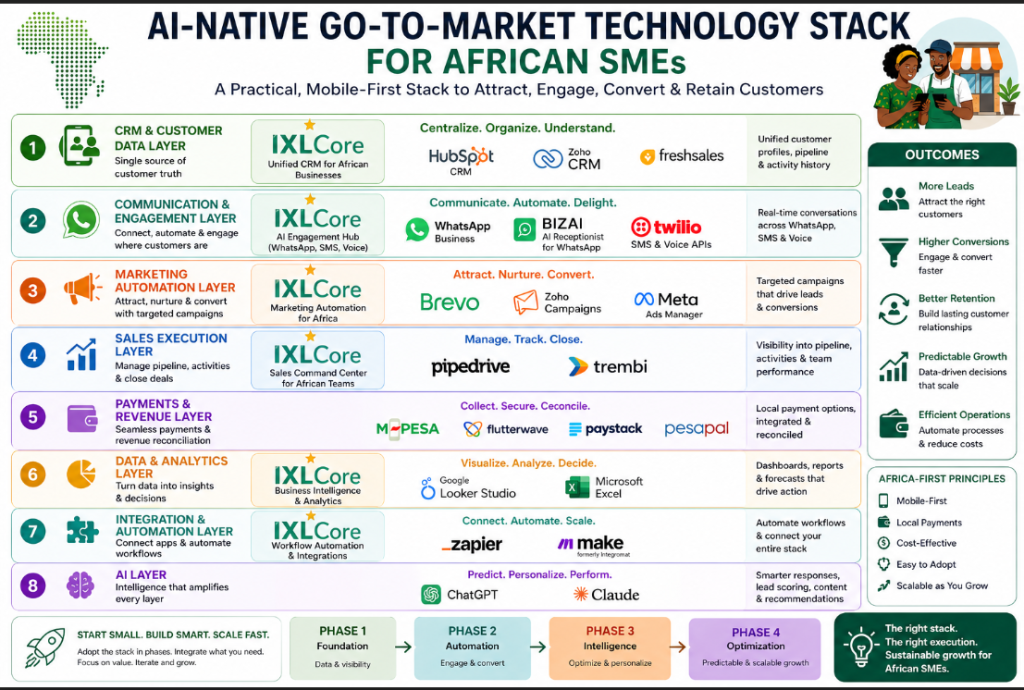
Across Africa, small and medium-sized enterprises (SMEs) are entering a decisive phase of digital transformation. Growth is no longer constrained primarily by market access—it is constrained by how effectively businesses can attract, convert, and retain customers at scale. The go-to-market (GTM) function, traditionally driven by manual processes and fragmented tools, is being redefined by AI-enabled, mobile-first, and data-driven systems. However, most global GTM playbooks do not translate cleanly into the African context. Infrastructure variability, mobile-first customer behavior, payment fragmentation, and cost sensitivity require a context-aware technology stack—not a copy-paste of enterprise SaaS architectures. This article outlines a practical, Africa-optimized GTM technology stack that SMEs can implement progressively to build a scalable, intelligent, and cost-efficient growth engine.
The Strategic Shift From Campaigns to Growth Systems
Historically, SMEs have approached marketing and sales as isolated activities that involve running occasional campaigns, managing leads manually and tracking customers across disconnected tools. This model is increasingly uncompetitive. The modern approach is to build a continuous growth system—a structured environment where customer data is unified, engagement is automated, decisions are informed by real-time signals and AI augments execution. The GTM tech stack is the foundation of this system.
The Africa Reality Why a Specialized Stack is Required
Before defining the stack, it is critical to understand the operating environment:
- Mobile-first engagement
Customers interact primarily via WhatsApp, SMS, and social platforms—not email. - Payment diversity
Mobile money platforms such as M-PESA dominate transactions, requiring local integrations. - Data fragmentation
Customer information is often scattered across chat apps, spreadsheets, and manual records. - Cost constraints
SMEs must prioritize tools that deliver immediate ROI with minimal upfront investment. - Trust-driven transactions
Human interaction remains critical in many purchasing decisions.
A viable GTM stack must address these realities directly.
The 8-Layer AI-Native GTM Stack
1. CRM and Customer Data Layer: The Foundation
At the core of any effective GTM system is a Customer Relationship Management (CRM) platform. This is where all customer interactions, transactions, and pipeline activities are centralized. For African SMEs, the CRM must: support mobile-first usage, integrate with local payment systems and remain affordable and easy to deploy.
Tools such as IXLCore CRM provide strong options depending on business maturity. The key objective is not sophistication—it is data consolidation and visibility. A simple, well-maintained CRM is more valuable than a complex system that is poorly adopted.
2. Communication and Engagement Layer: Where Conversion Happens
In Africa, GTM success is heavily dependent on direct customer communication channels, particularly WhatsApp. This layer includes WhatsApp Business for day-to-day engagement, SMS as a fallback channel and Voice for high-trust interactions.
Automation platforms such as IXLCore and API providers enable SMEs to respond to inquiries instantly, automate follow-ups and handle high volumes of customer interactions. The goal is to create a responsive, always-on engagement model without scaling headcount.
3. Marketing Automation Layer: Demand Generation Engine
Marketing in African SMEs is increasingly driven by digital channels, especially social media. Key tools include Brevo for email and SMS campaigns, IXLCore Campaigns for integrated automation and Meta Ads Manager for targeted acquisition. Unlike Western markets, email is often secondary. The most effective loop is: Social media → WhatsApp → Conversion. Marketing automation should focus on trigger-based engagement, not mass campaigns.
4. Sales Execution Layer: Structuring the Pipeline
Sales processes in many SMEs remain informal. A structured sales execution layer introduces, pipeline visibility, deal tracking and accountability. Tools such as IXLCore offer intuitive interfaces that sales teams can adopt quickly. This layer is especially important for B2B SMEs, businesses with field sales teams and distributor-driven models. The outcome is a shift from reactive selling to managed pipeline execution.
5. Payments and Revenue Layer: Closing the Loop
A GTM system is only as effective as its ability to convert transactions. In Africa, integrating local payment systems such has mobile money platforms is non-negotiable. Seamless payment integration reduces friction, increases conversion rates and enables real-time revenue tracking. Many SMEs underestimate this layer, yet it is often the largest driver of GTM performance improvement.
6. Data and Analytics Layer: From Data to Decisions
Once systems are in place, SMEs must extract value from their data. Lightweight tools such as IXLCore, Google Looker Studio and Microsoft Excel are sufficient for most SMEs to track performance to monitor conversion rates and forecast revenue. The emphasis should be on clarity and usability, not complex analytics.
7. Integration and Automation Layer: Connecting the Stack
A fragmented stack creates inefficiency. Integration tools such as IXLCore act as the “glue” that connects systems. Examples of automation include sending WhatsApp messages when a lead is created, updating CRM records after payments and triggering follow-ups after inactivity. This layer transforms isolated tools into a coordinated GTM system.
8. AI Layer: The Emerging Differentiator
Artificial intelligence is rapidly becoming the most powerful layer in the stack. Tools such as ChatGPT and Claude can be used to generate customer responses, qualify leads, create marketing content and analyze data trends. For more advanced SMEs, AI can be embedded directly into workflows, enabling automated customer engagement, predictive recommendations and intelligent upselling. The role of AI is not to replace human interaction, but to amplify efficiency and scale execution.
Stack Configurations by SME Maturity
Starter SMEs
- CRM: IXLCore CRM
- Communication: WhatsApp Business
- Payments: M-PESA
- Analytics: IXLCore
Focus: visibility and structure
Growth SMEs
- CRM: IXLCore CRM
- Engagement: WhatsApp + automation
- Payments: Flutterwave or Paystack
- Marketing: IXLCore
- Integration: IXLCore
Focus: automation and conversion optimization
Advanced SMEs
- CRM: More complex CRM
- AI-enabled engagement
- Integrated payments
- Looker Studio dashboards
- Embedded AI tools
Focus: predictable, scalable growth
Implementation Principles
To successfully deploy this stack, SMEs should follow five key principles:
1. Start Simple, Then Scale
Avoid over-engineering. Begin with core systems and expand gradually.
2. Prioritize Adoption Over Features
A simple tool used consistently is more valuable than a powerful tool that is ignored.
3. Focus on Integration Early
Disconnected tools create inefficiencies. Ensure systems can communicate.
4. Optimize for Mobile
Design workflows around mobile usage—for both customers and staff.
5. Maintain Human Touchpoints
Automation should enhance, not replace, trust-building interactions.
Common Pitfalls to Avoid
- Over-investing in complex tools too early
- Neglecting data quality and consistency
- Automating without clear processes
- Ignoring local payment integration
- Losing brand voice through poor AI usage
Avoiding these pitfalls is critical to realizing value from the stack.
The Strategic Outcome: A System of Growth
When implemented correctly, this GTM stack enables SMEs to transition from manual, inconsistent sales processes to structured, data-driven growth systems. The benefits include, faster response times, higher conversion rates, improved customer retention and predictable revenue. More importantly, it creates a competitive advantage that compounds over time. As data accumulates and AI systems improve, the business becomes increasingly efficient and responsive.
Final Perspective
The opportunity for African SMEs is not to replicate global enterprise architectures—it is to build lean, intelligent systems tailored to local realities. The winning businesses will not necessarily have the most advanced technology. They will have the most structured data, the most responsive engagement and the most disciplined execution. In a market where speed, trust, and adaptability define success, the right GTM tech stack is no longer optional—it is foundational to sustainable growth.
If approached strategically, this stack is not just a collection of tools, it is the operating system for the modern African SME.
Follow me on LinkedIn for more insights on AI and Technology in African Business Operations