Using Agentic AI to Transform Operations and Drive Enterprise Growth
Artificial intelligence is rapidly evolving from a productivity assistant into something far more transformative. For years, organizations adopted AI primarily to automate repetitive work, accelerate reporting, and improve customer interactions. Today, however, businesses are entering a new operational era shaped by Agentic AI — intelligent systems capable of reasoning, planning, coordinating workflows, and executing actions autonomously across enterprise environments.
This evolution is fundamentally changing how business teams collaborate.
In traditional organizations, collaboration is often slowed by disconnected systems, departmental silos, delayed communication, fragmented data, and manual coordination processes. Teams spend enormous amounts of time chasing updates, scheduling meetings, following up on approvals, reconciling information between systems, and managing operational dependencies.
Agentic AI introduces a completely different operating model.
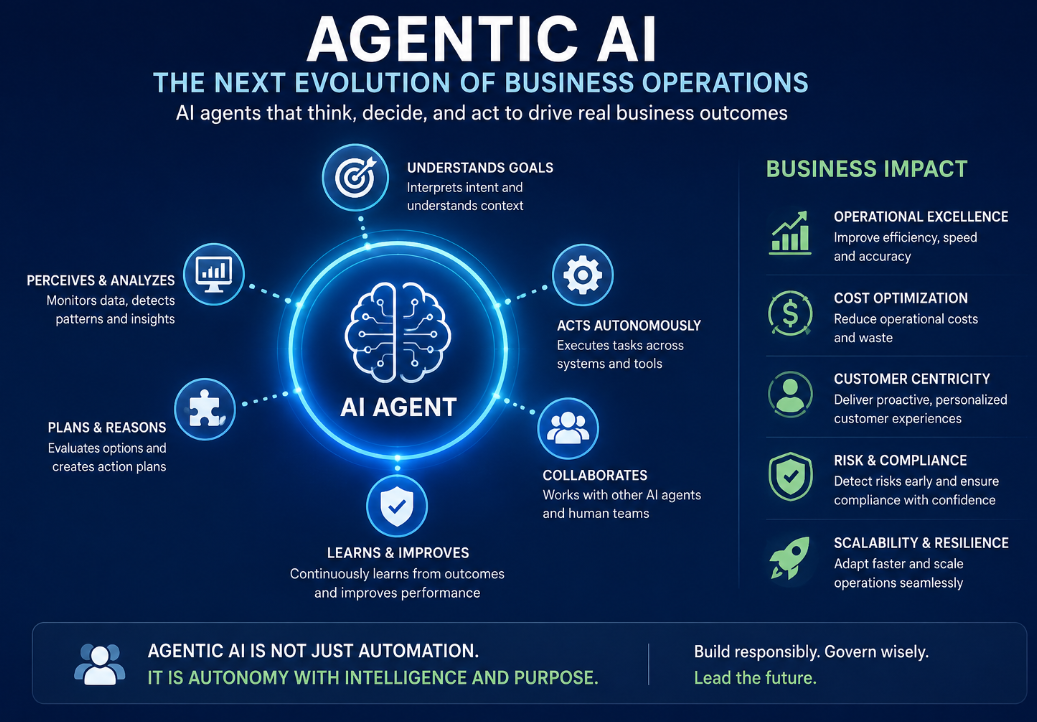
Instead of acting as passive software tools waiting for instructions, AI agents can now function as intelligent operational participants that actively coordinate tasks, facilitate communication, analyze information in real time, and support business execution across multiple departments simultaneously.
For modern enterprises, this represents more than operational automation. It represents the emergence of collaborative intelligence at scale.
The organizations that successfully integrate Agentic AI into their operational structure will likely gain significant advantages in efficiency, responsiveness, scalability, and decision-making speed over competitors still dependent on manual coordination models.
Agentic AI in Business Operations: Moving Beyond Traditional Automation
Most forms of business automation have historically relied on rigid rule-based workflows. A process begins when a trigger occurs, and the system executes predefined instructions. While useful, these automations struggle in dynamic environments where context, judgment, and adaptability are required.
Agentic AI changes this dramatically.
Agentic systems can understand goals, interpret context, interact with multiple enterprise systems, make operational decisions within defined boundaries, and continuously adapt based on changing conditions.
This means AI is no longer limited to supporting isolated tasks. It can coordinate entire workflows between departments.
For example, when a sales team closes a major contract, an agentic AI system can immediately trigger operational processes across the organization. It can notify procurement teams to prepare inventory, coordinate onboarding schedules with customer success teams, alert finance departments to generate invoices, update CRM and ERP platforms, assign implementation tasks to operations teams, and initiate customer communication workflows automatically.
What previously required several emails, meetings, and manual follow-ups can now occur seamlessly and continuously.
This transformation allows organizations to reduce operational friction while dramatically improving collaboration between business units.
AI Collaboration Between Departments and Cross-Functional Teams
One of the largest operational problems facing enterprises today is departmental fragmentation. Marketing, finance, operations, sales, human resources, and customer support often operate using different systems, processes, and data environments.
As a result, information moves slowly.
Agentic AI can function as the intelligent coordination layer connecting these departments in real time.
Instead of relying on employees to manually relay information between teams, AI agents can synchronize operational workflows automatically.
A customer support team, for instance, may identify a surge in complaints regarding delayed product deliveries. An AI agent can instantly alert logistics teams, notify procurement departments of supply shortages, provide sales teams with updated delivery timelines, and inform marketing teams to adjust customer messaging proactively.
This creates a coordinated organizational response centered around operational intelligence rather than reactive communication.
The result is faster problem resolution, improved customer experience, and greater organizational alignment.
More importantly, it allows employees to focus on higher-value work instead of administrative coordination.
Using Agentic AI for Real-Time Decision Making
One of the greatest barriers to effective collaboration is the delay involved in gathering and analyzing information before decisions can be made.
Business leaders often rely on outdated reports, incomplete data, and fragmented operational visibility when making strategic decisions.
Agentic AI enables continuous operational intelligence.
AI agents can monitor enterprise systems in real time, analyze large volumes of operational data, identify emerging risks, detect anomalies, and generate actionable insights continuously.
Imagine a leadership meeting where AI systems provide:
- Live inventory forecasts
- Customer sentiment analysis
- Financial risk indicators
- Supply chain disruption alerts
- Workforce productivity insights
- Revenue trend predictions
Instead of spending valuable time compiling information manually, teams can collaborate around continuously updated intelligence.
This significantly improves operational responsiveness and enables organizations to make informed decisions faster.
In highly competitive industries, decision-making speed increasingly determines market advantage.
How AI Agents Improve Team Productivity and Workflow Efficiency
Modern organizations spend a substantial portion of their operational time managing workflows rather than executing strategic objectives. Meetings, approvals, task assignments, reporting cycles, and status updates consume enormous amounts of employee productivity. Agentic AI can automate much of this operational coordination.
AI agents can:
- Prioritize tasks dynamically
- Assign work based on workload and expertise
- Track project dependencies
- Monitor deadlines automatically
- Escalate high-risk issues proactively
- Coordinate approvals across departments
- Generate real-time status reports
For example, in IT operations, AI agents can automatically categorize incidents, route tickets to the appropriate specialists, identify recurring infrastructure problems, and initiate remediation workflows before outages escalate.
In human resources, AI systems can coordinate candidate screening, interview scheduling, onboarding workflows, and employee support interactions simultaneously.
In finance departments, AI agents can automate invoice reconciliation, monitor spending anomalies, flag compliance risks, and streamline approval chains. The cumulative effect is significant operational acceleration across the enterprise.
Multi-Agent AI Systems and Autonomous Enterprise Collaboration
One of the most transformative developments in enterprise AI is the rise of multi-agent collaboration. Instead of relying on a single AI system, organizations can deploy multiple specialized AI agents that work together autonomously. Each agent focuses on a specific operational domain while collaborating with other agents to achieve broader business objectives. For example:
- A finance AI agent detects unusual purchasing activity
- A procurement AI agent verifies vendor transactions
- A cybersecurity AI agent analyzes access patterns
- A compliance AI agent reviews policy adherence
- A legal AI agent evaluates contractual exposure
- Human executives receive a consolidated operational summary
This coordinated intelligence model allows organizations to identify and respond to operational issues with unprecedented speed and accuracy. Over time, businesses may increasingly operate through interconnected ecosystems of AI agents collaborating alongside human teams. This marks the beginning of what many experts now describe as the autonomous enterprise.
Agentic AI and Remote Team Collaboration
Remote and hybrid work environments have created new collaboration challenges for businesses worldwide. Distributed teams often struggle with:
- Communication gaps
- Reduced operational visibility
- Delayed responses
- Workflow fragmentation
- Inconsistent project coordination
Agentic AI can significantly improve collaboration in these environments. AI agents can automatically summarize meetings, track action items, coordinate schedules, monitor project milestones, identify workflow bottlenecks, and ensure accountability across distributed teams. Instead of employees manually chasing updates, AI systems maintain operational continuity in the background.
This becomes especially valuable for multinational organizations operating across multiple time zones and geographies. For businesses in Africa and other emerging markets, where distributed operations are increasingly common, AI-enabled collaboration can help organizations scale more effectively without dramatically increasing administrative overhead.
Customer-Centric Collaboration Through Agentic AI
Many businesses still operate in ways where departments interact with customers independently rather than collaboratively.
Sales teams focus on acquisition.
Support teams focus on issue resolution.
Marketing teams focus on engagement.
Operations teams focus on fulfillment.
The customer experience often becomes fragmented.
Agentic AI enables organizations to unify customer engagement across the enterprise. For example, if AI systems detect declining customer satisfaction patterns, they can automatically:
- Alert customer success teams
- Notify product departments of recurring issues
- Recommend retention campaigns to marketing teams
- Inform sales teams of account risks
- Escalate operational problems to leadership
This creates a coordinated enterprise response centered around customer outcomes rather than isolated departmental activities. Organizations that achieve this level of operational intelligence will likely outperform competitors still operating with disconnected customer engagement models.
AI Governance, Cybersecurity, and Human Oversight
While the benefits of agentic AI are substantial, businesses must recognize that these systems also introduce new operational and security risks. When AI agents can access enterprise systems, initiate workflows, analyze customer data, and influence operational decisions, they effectively become highly privileged digital identities inside the organization. Without strong governance, these systems can create cybersecurity vulnerabilities, compliance exposure, and operational risks. Organizations implementing agentic AI must establish:
- Role-based access controls
- Least-privilege security models
- Audit trails for AI actions
- Human approval mechanisms
- Compliance monitoring frameworks
- Ethical operational guidelines
- Continuous AI oversight processes
The future of enterprise AI will not simply depend on automation capability. It will depend on operational trust. Businesses that balance innovation with governance will build more sustainable and resilient AI-driven operating models.
The Future of Human and AI Collaboration in Business
The future workplace will not be defined by humans competing against AI. It will be defined by humans collaborating with intelligent systems to achieve outcomes that neither could accomplish alone.
Agentic AI will increasingly handle:
- Operational coordination
- Workflow orchestration
- Real-time analysis
- Repetitive execution tasks
- Data-driven optimization
Human teams will focus more heavily on:
- Strategic leadership
- Creativity and innovation
- Relationship management
- Ethical decision-making
- Complex problem-solving
- Business growth and transformation
This shift will fundamentally redefine organizational structures over the next decade. Companies that embrace this transformation early will likely become more adaptive, efficient, and scalable than organizations still dependent on manual coordination and fragmented workflows.
Why Agentic AI Will Redefine Business Collaboration
Agentic AI is no longer a futuristic concept. It is rapidly becoming the operational intelligence layer of modern enterprises. Businesses are moving beyond simple automation toward intelligent systems capable of coordinating workflows, supporting real-time decisions, improving cross-functional collaboration, and enabling autonomous enterprise operations.
The implications for productivity, scalability, customer experience, and operational resilience are enormous. Organizations that strategically adopt Agentic AI will not only improve efficiency. They will fundamentally transform how teams communicate, collaborate, and execute business operations. The future of business collaboration will increasingly involve humans and AI agents working together as integrated operational ecosystems. And the companies that learn how to build, govern, and scale these collaborative intelligence models effectively will help define the next generation of enterprise leadership in the AI era.
Follow me on LinkedIn for more insights on Artificial Intelligence applications in real life business operations and read more about deployment of AI in business operations in Africa