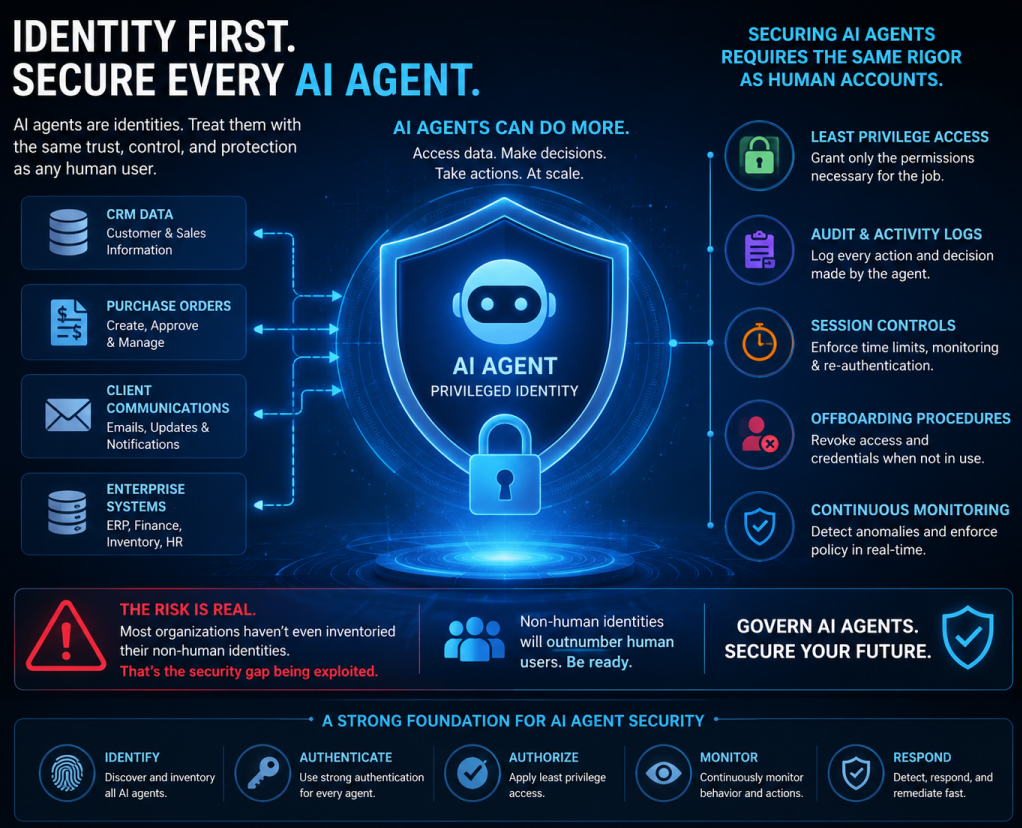
The conversation around artificial intelligence in the enterprise has rapidly evolved. What began as experimentation with AI copilots—tools designed to assist humans—has now transitioned into something far more consequential: AI agents that act, decide, and execute. This shift is not incremental. It represents a fundamental redefinition of how work is performed, how systems are governed, and how security must be enforced.
What are AI agents in Cybersecurity?
AI agents are autonomous systems that perform tasks, make decisions, and interact with enterprise platforms.
They are considered non-human identities and must be secured using identity and access management control.
At the center of this transformation lies a concept many organizations are only beginning to understand: AI agents are not just tools. They are identities. This distinction matters more than it may initially appear. When an AI agent can query your CRM, approve purchase orders, trigger workflows, and communicate directly with customers, it is no longer operating as a passive system. It is functioning as an active participant within your enterprise environment. In many cases, it holds privileges comparable to, or even exceeding, those of human administrators. And yet, in most organizations today, these non-human identities are not being managed with the same level of rigor.
AI agents in business operations
That gap is quickly becoming one of the most significant—and most exploited—security vulnerabilities in modern enterprise IT. To understand the magnitude of the issue, it is important to examine how AI agents are being integrated into business operations. Across industries, organizations are embedding AI agents into core workflows: finance teams are using them to automate approvals and reconciliation, sales teams rely on them to engage customers and manage pipelines, and operations teams deploy them to optimize supply chains and internal processes. These agents are not merely supporting decisions; they are increasingly making decisions.
This operational autonomy introduces a new category of identity: the non-human workforce. Unlike traditional service accounts or APIs, AI agents are dynamic. They learn, adapt, and interact with multiple systems simultaneously. They can initiate actions, respond to external inputs, and operate continuously without fatigue. In effect, they represent a new layer of digital labor—one that scales rapidly and operates at machine speed. However, while organizations have spent decades refining identity and access management (IAM) practices for human users, they have not extended those same principles to AI agents. This oversight is not due to negligence, but rather to the speed at which AI capabilities have advanced. Governance frameworks, security models, and compliance structures have simply not kept pace. The result is an environment where AI agents often operate with excessive privileges, limited oversight, and insufficient accountability.
Consider a typical scenario: an AI agent is granted access to a company’s CRM system to assist with customer engagement. Over time, its capabilities are expanded—it begins generating quotes, updating records, and even initiating communications with clients. Eventually, it is integrated with financial systems, enabling it to trigger billing processes or approve transactions based on predefined rules.At each stage, access is added. Rarely is it revisited, audited, or constrained. What emerges is a highly capable digital identity with broad permissions across multiple systems. If compromised—whether through misconfiguration, exploitation, or manipulation—the potential impact is significant. Unauthorized transactions, data exfiltration, reputational damage, and regulatory violations are all plausible outcomes. This is why AI agents must be treated as privileged identities.
Privileged identities
The principle of least privilege, long a cornerstone of cybersecurity, becomes even more critical in this context. AI agents should be granted only the permissions necessary to perform their specific functions—nothing more. Access should be tightly scoped, continuously monitored, and regularly reviewed. Yet in practice, many organizations default to convenience over control, granting broad access to accelerate deployment and functionality. This approach is not sustainable.Equally important is the need for comprehensive auditability. Every action taken by an AI agent must be logged, traceable, and attributable. Unlike human users, AI agents do not possess intent in the traditional sense, but their actions can still have material consequences. Organizations must be able to answer fundamental questions: What did the agent do? When did it do it? Why was the action taken? And under whose authority? Without this level of visibility, accountability becomes limited and risk becomes difficult to manage. Session management is another often-overlooked aspect of AI agent security. Just as human sessions are subject to time limits, re-authentication requirements, and monitoring, AI agents should operate within defined boundaries. Persistent, always-on access creates opportunities for misuse and exploitation. Implementing session controls ensures that access is not only granted appropriately but also maintained responsibly.
Offboarding, too, must be reimagined in the age of AI agents. In traditional environments, offboarding a user involves disabling accounts, revoking access, and ensuring that credentials are no longer valid. With AI agents, the process is more complex. Agents may be embedded in workflows, integrated across systems, and dependent on various data sources. Proper offboarding requires a systematic approach to decommissioning—ensuring that all access points are identified and revoked, and that residual dependencies are addressed. Failure to do so can leave dormant but still active identities within the system—an ideal target for malicious actors. Beyond these technical controls, there is a broader governance challenge that organizations must confront. The rise of AI agents necessitates a shift from perimeter-based security models to identity-centric frameworks. In a world where agents operate across cloud environments, SaaS platforms, and internal systems, the traditional notion of a network boundary becomes less relevant. Identity becomes the primary control plane.
Who is responsible for an AI agent’s actions?
This shift has implications not only for security teams but also for executive leadership. The introduction of AI agents into the enterprise is not merely a technological upgrade; it is an organizational transformation. It requires new policies, new roles, and new accountability structures. Who is responsible for an AI agent’s actions? How are decisions audited and validated? What governance mechanisms ensure that agents operate within defined ethical and regulatory boundaries? These are not hypothetical questions. They are operational imperatives. Regulatory compliance adds another layer of complexity. As governments and regulatory bodies begin to address the implications of AI in business operations, organizations will be required to demonstrate not only that their systems are secure, but also that they are governed responsibly. This includes maintaining detailed records of AI-driven decisions, ensuring transparency in automated processes, and implementing safeguards against bias and misuse. AI agents, in this context, become both an asset and a liability. They can drive efficiency, reduce costs, and enhance customer experiences, but they also introduce new risks that must be actively managed.
One of the most pressing issues is the lack of visibility into non-human identities. Many organizations simply do not have a complete inventory of their AI agents, service accounts, and automated processes. This blind spot creates an environment where unmanaged identities proliferate, each with its own set of permissions and potential vulnerabilities. Addressing this requires a foundational step: discovery. Organizations must begin by identifying all non-human identities within their environment. This includes not only AI agents but also scripts, bots, APIs, and service accounts. Once identified, these identities must be classified, assessed, and brought under a unified governance framework. Only then can effective controls be implemented.From there, the focus shifts to enforcement.
Policies governing access, behavior, and lifecycle management must be clearly defined and consistently applied. Automation can play a role here, enabling real-time monitoring and enforcement of policies. However, automation must be complemented by human oversight. While AI agents can operate independently, they should not operate unchecked. The concept of “human-on-the-loop” becomes critical. Rather than being directly involved in every decision, humans oversee the system, intervene when necessary, and ensure that operations align with organizational objectives and risk tolerance. This balance between autonomy and control is at the heart of successful AI adoption. Ultimately, the organizations that will thrive in this new era are those that recognize the dual nature of AI agents. They are both enablers of transformation and potential sources of risk. Managing them effectively requires a holistic approach—one that integrates technology, governance, and culture.
Integrating AI agents with a plan
It is not enough to deploy AI agents. They must be engineered into the fabric of the enterprise with discipline and intent. This includes investing in identity and access management systems that can accommodate non-human identities, developing governance frameworks tailored to AI-driven operations, and fostering a culture of accountability and transparency. It also means rethinking traditional assumptions about security, recognizing that the most critical vulnerabilities may no longer reside at the network edge, but within the identities that operate inside it. The transition from AI copilots to AI agents marks a new phase in the evolution of enterprise IT. It is a shift from assistance to autonomy, from tools to actors, from static systems to dynamic participants. And with that shift comes a new responsibility.
Securing AI agents is not a future concern. It is a present necessity. The organizations that act now—establishing robust identity frameworks, implementing rigorous controls, and embracing a proactive approach to governance—will be best positioned to harness the full potential of AI while mitigating its risks. Those that delay may find themselves exposed in ways they did not anticipate. Because in this new landscape, every AI agent is an identity. And every identity, if not properly secured, is a potential point of failure. The question is no longer whether AI agents will become integral to enterprise operations. That future is already unfolding. The question is whether organizations are prepared to secure them.
Follow me on LinkedIn for more insights on AI in business operations